
A/B Testing for Machine Learning Models
A Complete Beginner's Guide to Building Better AI Systems
🚀 Introduction
Imagine you've trained two machine learning models.
Model A → Accuracy = 91%
Model B → Accuracy = 93%
Obviously, you'll choose Model B... right?
Not always!
Offline accuracy doesn't guarantee that users will have a better experience. A model that performs well on a test dataset might reduce clicks, increase response time, or hurt customer satisfaction in the real world. That's why companies like Netflix, Google, Amazon, Meta, and Spotify use A/B Testing before fully deploying a new model. Online experiments help determine whether a candidate model truly improves business outcomes compared with the current production model.
What is A/B Testing?
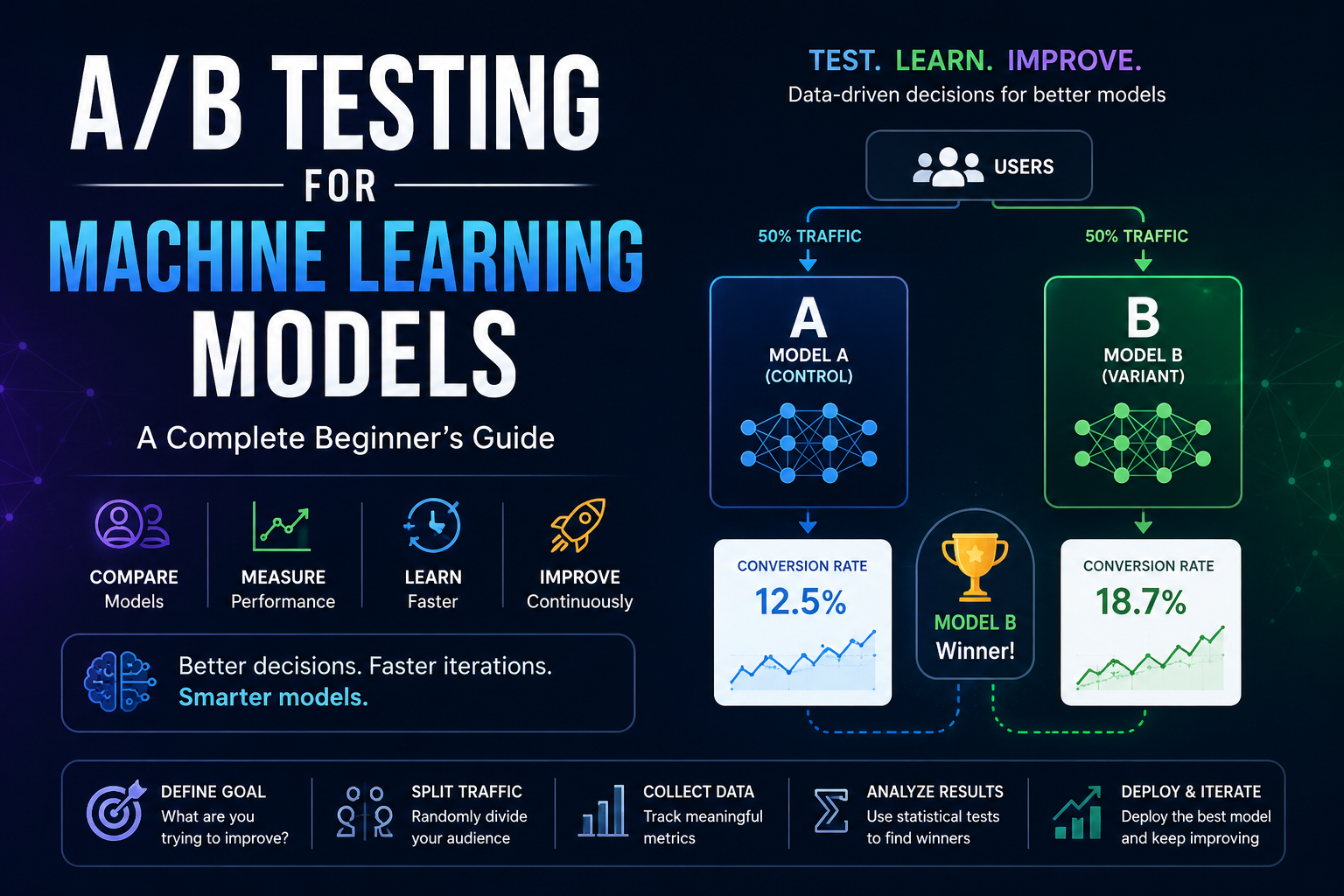
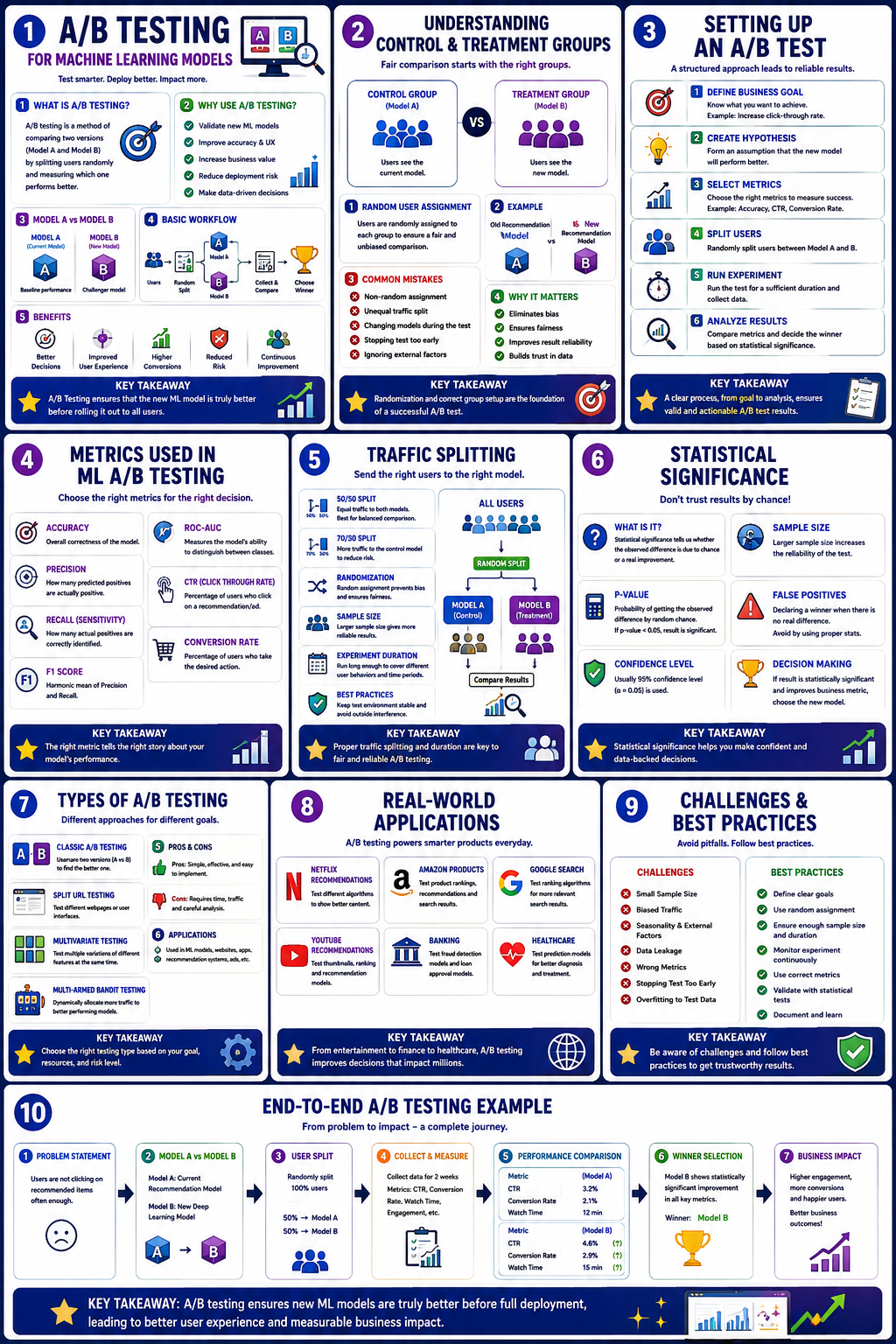
A/B Testing is a controlled experiment where two versions of a machine learning model are shown to different groups of users at the same time.
Version A → Current production model
Version B → New candidate model
Their performance is compared using real user interactions.
Think of it as a real-world exam for your ML model.
Why Accuracy Alone Isn't Enough
Suppose you build a recommendation system.
Offline Results
Model A Accuracy = 90%
Model B Accuracy = 94%
Everything looks great.
But after deployment:
Model B recommendations are slower.
Users click fewer recommendations.
Revenue drops.
Although accuracy improved, the business became worse.
This is exactly why A/B Testing is needed.
Real-Life Example
Netflix
Netflix develops a new recommendation algorithm.
Instead of replacing the old system for everyone,
they send
90% users → Old Model
10% users → New Model
After two weeks they compare
Watch Time
CTR
User Retention
Subscription Renewal
If the new model performs better, Netflix gradually increases traffic.
A/B Testing Workflow
Train Multiple Models
        │
Offline Evaluation
        │
Choose Best Candidate
        │
Deploy Two Models
        │
Split Users (50%-50%)
        │
Collect User Feedback
        │
Analyze Results
        │
Winner Selected
Step-by-Step Process
Step 1: Train Multiple Models
Example
Random Forest
XGBoost
Neural Network
CatBoost
Step 2: Offline Evaluation
Metrics
Accuracy
Precision
Recall
F1 Score
ROC-AUC
Choose the best candidate.
Step 3: Deploy Both Models
Production Model
↓
New Model
Both stay live simultaneously.
Step 4: Split Users
Example
10000 Users
5000 → Model A
5000 → Model B
Users are assigned randomly to avoid bias and ensure a fair comparison.
Metrics Used
| Metric | Meaning |
|---|---|
| CTR | Click Through Rate |
| Conversion Rate | Purchases |
| Revenue | Business Impact |
| User Retention | Returning Users |
| Session Duration | Engagement |
| Latency | Speed |
| Error Rate | Stability |
Example
Old Model
CTR = 12%
New Model
CTR = 16%
Improvement
= 4%
Percentage Improvement
=((16−12)/12)×100
=33.3%
Decision
Deploy Model B
Code Example (Python)
import numpy as np
from scipy.stats import ttest_ind

model_A = np.random.normal(12, 2, 1000)
model_B = np.random.normal(13.5, 2, 1000)

t_stat, p_value = ttest_ind(model_A, model_B)

print("P-value:", p_value)

if p_value < 0.05:
    print("Model B is significantly better")
else:
    print("No significant difference")
Applications
E-commerce
Product recommendation
Search ranking
Healthcare
Disease prediction
Treatment recommendation
Banking
Fraud Detection
Credit Risk
Social Media
Feed Ranking
Friend Suggestions
OTT Platforms
Movie Recommendation
Advantages
✔ Uses real users
✔ Reduces deployment risk
✔ Better business decisions
✔ Improves customer satisfaction
✔ Data-driven model selection
Disadvantages
❌ Needs enough users
❌ Can take days or weeks
❌ Expensive for large systems
❌ Ethical considerations in some domains
Best Practices
Test one major change at a time.
Define success metrics before starting.
Randomly split users and keep each user consistently assigned to one variant.
Run the experiment long enough to collect sufficient data.
Check statistical significance before declaring a winner.
Monitor guardrail metrics such as latency and error rate alongside business metrics.
Companies Using A/B Testing
Google
Netflix
Amazon
Meta (Facebook)
Spotify
Microsoft
Common Interview Questions
What is A/B Testing?
A method of comparing two versions of a model using real users.
Why use A/B Testing?
To validate whether a new model improves real-world business metrics.
What metrics are used?
CTR, Conversion Rate, Revenue, Retention, Latency, Error Rate.
Difference between Offline Evaluation and A/B Testing?
Offline Evaluation uses historical datasets, while A/B Testing evaluates models with live production traffic and real user behavior.
Conclusion
A/B Testing is one of the most important techniques in production machine learning. Instead of relying only on offline metrics like accuracy or F1-score, it measures how a model performs with real users and real business goals. By carefully designing experiments, choosing meaningful metrics, and validating results statistically, organizations can confidently deploy models that deliver measurable value.